
Choosing the 5 Best Red Dots with RMR Footprint gives you access to one of the most widely supported mounting patterns for optics-ready platforms. The footprint is used by numerous pistol optics and compatible mounting systems, making it easier to find a replacement optic or move between compatible platforms. However, not every compact red dot uses the RMR footprint, so checking compatibility before purchasing is essential.
RMR-footprint optics also come in several different configurations. Some use a simple single-dot reticle, while others offer multiple reticle choices. Housing materials, battery placement, window size, brightness controls, solar backup, and overall dimensions can also vary considerably.
In this guide, we look at the 5 Best Red Dots with RMR Footprint popular options for an RMR-footprint setup.
5 Best Red Dots with RMR Footprint
1. Trijicon RMR Type 2

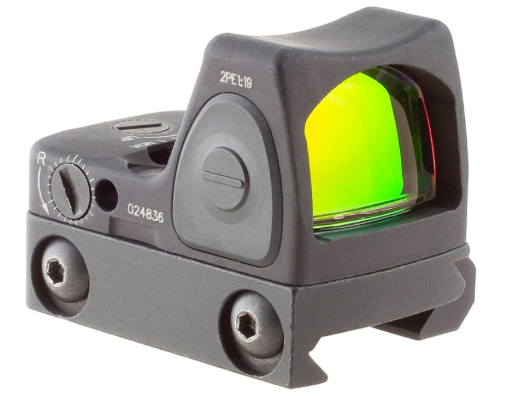
The Trijicon RMR Type 2 is the optic most closely associated with the RMR mounting standard. Its compact form makes it suitable for platforms designed around the RMR pattern, while its established design has made it a common reference point when comparing compatible red dots.
One of the main advantages of the RMR Type 2 is its compact footprint and relatively streamlined housing. This can be useful when the goal is to keep the overall optic package relatively small. The optic is available in several configurations, allowing users to choose a setup that matches their preferred aiming-point size and illumination system.
The RMR Type 2 also has a large ecosystem of compatible mounting solutions. An RMR-compatible platform can therefore provide flexibility when choosing between different optics that share the same mounting pattern. Even so, the optic cut, screws, mounting plate, and manufacturer’s specifications should always be checked before installation.
Another consideration is the optic’s traditional open-emitter design. This keeps the sight relatively compact, but the emitter is exposed rather than enclosed behind a forward lens. Users who prefer an enclosed emitter may therefore want to consider a different optic design.
Features
- RMR footprint
- Compact open-emitter design
- Multiple configurations
- Adjustable LED versions available
- Compact housing
Pros
- RMR-compatible
- Compact design
- Multiple configurations
- Established mounting ecosystem
Cons
- Premium pricing
2. Holosun HS507C X2
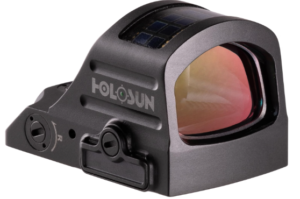
The Holosun HS507C X2 is a versatile RMR-footprint optic with a selectable multi-reticle system. Holosun lists the optic as having a 2 MOA dot and 32 MOA circle, allowing the user to select the dot, circle, or combined reticle configuration.
The HS507C X2 uses a 7075-T6 aluminum housing and has a window measuring approximately 0.91 by 0.63 inches. Its compact dimensions make it suitable for optics-ready platforms designed around the RMR footprint.
Power management is another notable feature. The optic uses a CR1632 battery in a side-mounted tray, meaning the battery can be replaced without removing the optic from the mounting surface. Holosun also lists Solar Failsafe and Shake Awake technology among its features.
The selectable reticle gives the HS507C X2 more flexibility than a conventional single-dot optic. Users who prefer a simple aiming point can select the 2 MOA dot, while the circle-dot arrangement provides a different visual presentation.
Features
- RMR footprint
- 2 MOA dot
- 32 MOA circle
- Selectable reticle
- Solar Failsafe
- Shake Awake
- Side-loading CR1632 battery
- 7075-T6 aluminum housing
Pros
- Versatile reticle
- RMR compatibility
- Side battery tray
- Solar backup
- Compact design
Cons
- More features than needed for a simple-dot user
3. Holosun HS508T X2

The Holosun HS508T X2 takes the familiar RMR-footprint format and combines it with a Grade 5 titanium housing. Holosun lists the optic as an RMR-footprint sight with a 2 MOA dot, 32 MOA circle, or combined circle-and-dot reticle configuration.
The titanium construction is one of the main differences between the HS508T X2 and many conventional aluminum-bodied optics. The manufacturer specifies a 2-ounce weight and a 0.63 by 0.91-inch window.
The HS508T X2 also incorporates several electronic features, including Solar Failsafe, Shake Awake, Lockout Mode, and a side-loading CR1632 battery. The side battery compartment allows battery replacement without removing the optic.
Reticle flexibility is another feature worth considering. The multi-reticle system allows users to select between the 2 MOA dot, 32 MOA circle, or combined circle-dot arrangement. This gives the optic a broader range of aiming-point configurations than a single-dot sight.
The HS508T X2 is also listed with IP67 protection and 5000G vibration resistance. Those specifications provide useful information about the construction and environmental protection of the optic, although real-world performance will also depend on correct installation and maintenance.
Features
- RMR footprint
- Grade 5 titanium housing
- 2 MOA dot
- 32 MOA circle
- Multi-Reticle System
- Solar Failsafe
- Shake Awake
- Side-loading battery
Pros
- Titanium housing
- RMR compatibility
- Multiple reticle choices
- Solar backup
- Side battery access
Cons
- Heavier than some aluminum alternatives
4. Trijicon SRO
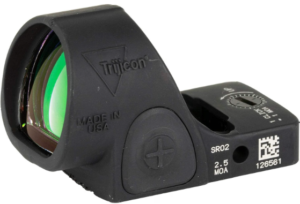
The Trijicon SRO is designed around a different form factor from the traditional RMR. Its larger viewing window gives it a noticeably different appearance and sight picture while maintaining compatibility with the RMR mounting ecosystem.
The larger window can be an important consideration for users who prefer more visual space around the illuminated aiming point. Compared with compact traditional RMR-style designs, the SRO’s larger viewing area gives the optic a more open presentation.
The SRO is available in different dot-size configurations. This allows users to choose an aiming point that matches their visual preferences and intended application rather than being limited to a single reticle size.
Its larger body should nevertheless be considered when checking compatibility. An optic can share the RMR footprint while having different external dimensions, so users should verify clearance, mounting requirements, and any equipment that needs to fit around the optic.
The SRO is therefore an interesting choice for someone who wants the RMR mounting pattern but prefers a larger-window optic. It occupies a different design category from the compact RMR Type 2 while retaining the familiar mounting interface.
Features
- RMR footprint
- Large viewing window
- Multiple dot-size options
- Open-emitter design
- 1x optical configuration
Pros
- Large viewing window
- RMR-compatible mounting
- Multiple dot options
- Distinctive sight picture
Cons
- Larger profile
5. Holosun HS407C X2
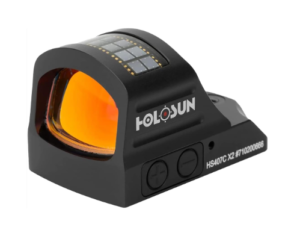
The Holosun HS407C X2 is designed for users who prefer a straightforward single-dot reticle. Holosun lists it as an RMR-footprint optic with a 2 MOA red dot, making it a simpler alternative to the multi-reticle HS507C X2.
The optic uses a 7075-T6 aluminum housing and has the same approximately 0.91 by 0.63-inch window dimensions listed for the HS507C X2. It is also specified with a 1x optical configuration, no parallax, and unlimited eye relief.
The HS407C X2 incorporates Solar Failsafe and Shake Awake technology. It also uses a side-mounted CR1632 battery tray, allowing battery replacement without removing the optic from the slide. Holosun lists up to 50,000 hours of battery life at setting 6.
The 2 MOA dot provides a clean reticle without the additional circle available on the HS507C X2. This can make the HS407C X2 a useful option for users who prefer a minimalist sight picture.
The optic is also listed with IP67 protection and a 5000G vibration specification. Its combination of RMR compatibility, simple reticle, solar backup, and side battery access makes it one of the more straightforward choices in this group.
Features
- RMR footprint
- 2 MOA red dot
- 7075-T6 aluminum housing
- Solar Failsafe
- Shake Awake
- Side-loading CR1632 battery
- IP67 protection
Pros
- Simple 2 MOA dot
- RMR compatibility
- Side battery tray
- Solar backup
- Compact design
Cons
- No circle-dot option
Related Articles:
Best Red dot Sight For Ruger Pc Carbine
Best Budget Red Dot Sight for Pistol
Factors to Consider When Choosing the 5 Best Red Dots with RMR Footprint
Reticle Design
Reticle choice is largely a matter of personal preference. A single 2 MOA dot provides a clean sight picture, while a multi-reticle system can offer additional configurations. The HS407C X2 uses a 2 MOA dot, whereas the HS507C X2 and HS508T X2 provide selectable circle and dot configurations.
Window Size
Window dimensions can influence the overall viewing experience. Larger-window optics such as the SRO have a different physical profile from more compact designs. Consider the optic’s dimensions as well as the footprint.
Size and Weight
The physical dimensions and weight of the optic should match the platform on which it will be installed. For example, Holosun lists the HS507C X2 at 1.5 ounces and the HS508T X2 at 2 ounces.
FAQs about the 5 Best Red Dots with RMR Footprint
- Does the Holosun HS507C X2 use an RMR footprint?
Yes. Holosun explicitly lists the HS507C X2 as having RMR footprint compatibility and direct RMR-footprint mounting.
- Does the Holosun HS407C X2 use an RMR footprint?
Yes. Holosun specifies RMR footprint compatibility for the HS407C X2.
- What is the difference between the HS407C X2 and HS507C X2?
The primary reticle difference is that the HS407C X2 uses a 2 MOA dot, while the HS507C X2 has a selectable 2 MOA dot and 32 MOA circle system. Both use the RMR footprint.
Conclusion
Choosing the 5 Best Red Dots with RMR Footprint gives you access to a broad range of optics with different reticles, housing materials, window sizes, and power-management features.
Before purchasing, verify the exact footprint, mounting hardware, dimensions, and manufacturer’s installation requirements for your specific platform. Doing so helps ensure that the optic and mounting system are actually compatible rather than relying only on the name “RMR footprint.”